
Foundations.
One online session of 90 minutes. How to notice when a colleague is struggling, how to start the conversation, and what to do with what you hear.
What the LifeLine Crew is
LifeLine Crew is a network of people across the emergency services, trained to notice when a colleague is struggling, start the conversation, and help them find the right support. The colleague beside you usually notices first. The LifeLine Crew exists so that noticing turns into something.
We would rather support started early than waited for a crisis. No one should reach breaking point alone.
The session
Foundations is the whole course. One online session of 90 minutes, straight through with no break, and a short pre-read. There is no series to commit to. Our advocates shaped it that way around shift patterns.
- 6 to 8 people and one facilitator. Small enough that everyone can speak.
- Online. Cameras are optional, and we use the chat throughout.
- Everything is discussed as one group. No breakout rooms.
- The practice uses written scenarios. Nobody is asked to share their own story.
It is deliberately simple. There is no theory to learn, just a handrail through conversations many of us already have on shift. The session talks directly about suicide, because plain words help people speak up, and it covers the everyday side of looking out for each other.
These are the first Foundations sessions we are running. We are an early-stage cause and we would rather say so than pretend otherwise.
Book a place.
- Wednesday 25 November9.00am to 10.30am · online · 6 to 8 people
- Tuesday 15 December8.00am to 9.30am · online · 6 to 8 people
- Tuesday 22 December8.00am to 9.30am · online · 6 to 8 people
- Tuesday 5 January10.00am to 11.30am · online · 6 to 8 people
- Friday 8 January8.30am to 10.00am · online · 6 to 8 people
- Tuesday 26 January4.00pm to 5.30pm · online · 6 to 8 people
Every date above is on the same page, so pick whichever one fits. Your place is confirmed by email within a few minutes, with the joining link, the pre-read and the images for your phone. If something comes up you can move yourself to another date, or cancel, from that same email, up to an hour before the session starts.
If none of these dates work, tell us and we will let you know the next ones.
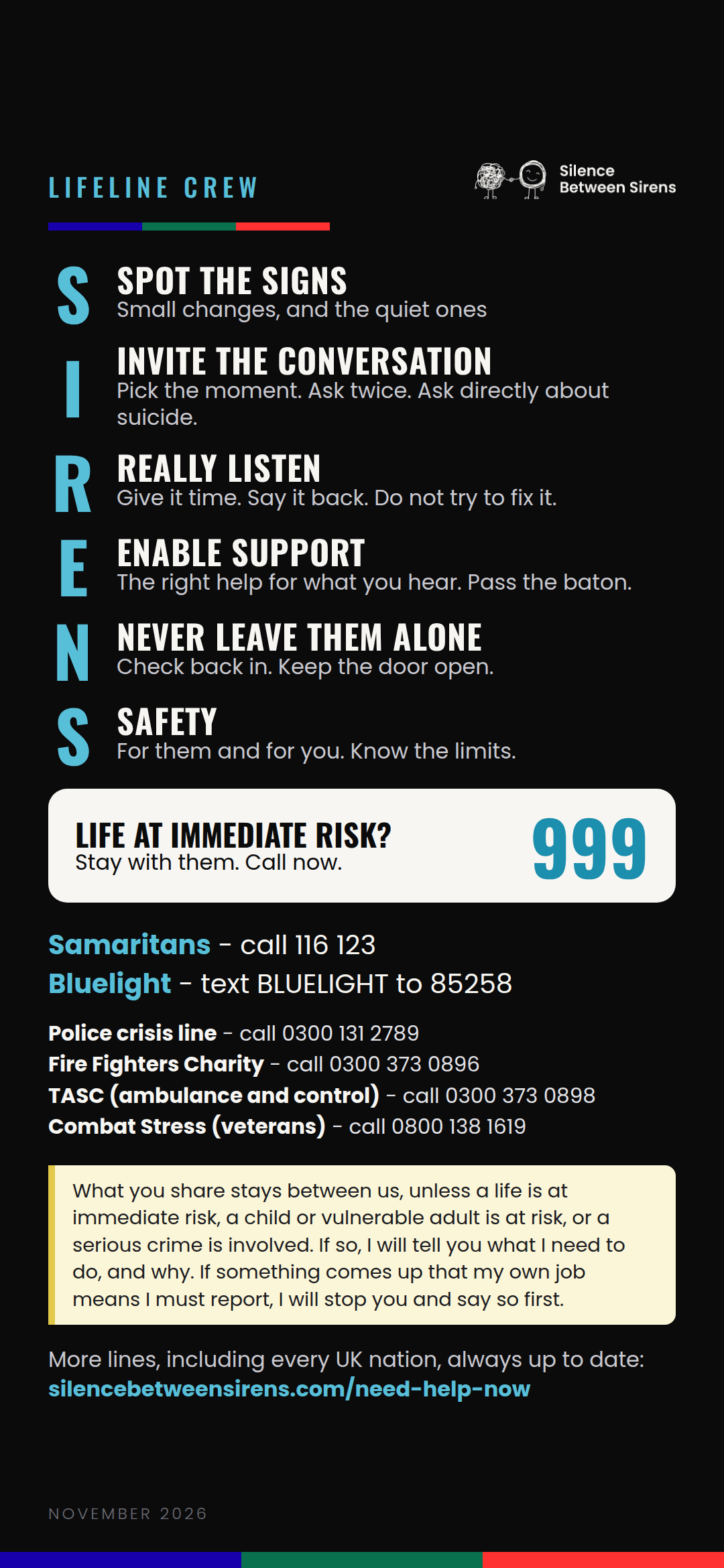
SIRENS: six steps, easy to remember on shift.
Six steps to hold on to, in whatever order the conversation takes. It is the frame LifeLine Crew members carry afterwards, on a card on their phone.
Spot the signs
Know your people. Small changes, and the quiet ones.
Invite the conversation
Side by side rather than face to face. Ask twice. Ask directly about suicide.
Really listen
Give it time. Say it back. Do not try to fix it.
Enable support
The right help for what you actually hear, and knowing when to pass the baton.
Never leave them alone
Check back in. Keep the door open.
Safety
For them and for you. The limits of confidentiality, and looking after yourself afterwards.
Draws on approaches that already work, including Samaritans, R U OK? and NICE guidance. It does not replace TRiM, Mental Health First Aid or professional help.
From thriving to struggling.
SIRENS starts with noticing. What matters is change from someone’s normal, rather than a label.
Thriving
- Sleeping well
- Usual humour
- Engaged with the team
- Making plans
Coping
- Tired, more irritable
- Less patience
- Still getting on with it
Struggling
- Withdrawn, quieter
- Drinking more
- Humour darker, or gone
- Sickness, or never off
In crisis
- Talks of being a burden
- Talks of wanting to die
- Giving things away
- Sudden calm after a hard time
People move along the scale in both directions. It is rarely one thing, so we teach people to notice the build-up rather than only the trigger.
Before and after
Before the session we send a pre-read. It takes about 20 minutes and follows the session page by page, so the time together goes on talking and practising rather than on being told things. The self-care plan on page 6 is worth starting beforehand, and we come back to it at the end.
Zero Suicide Alliance publish a free 30-minute course. We recommend it and do not require it. It covers the basics and we add the frontline context.
Afterwards, you keep three images on your phone, and the session is your handrail. If a conversation stays with you, talk to someone you trust, use the same support lines you would share with anyone else, or email us at info@silencebetweensirens.com.
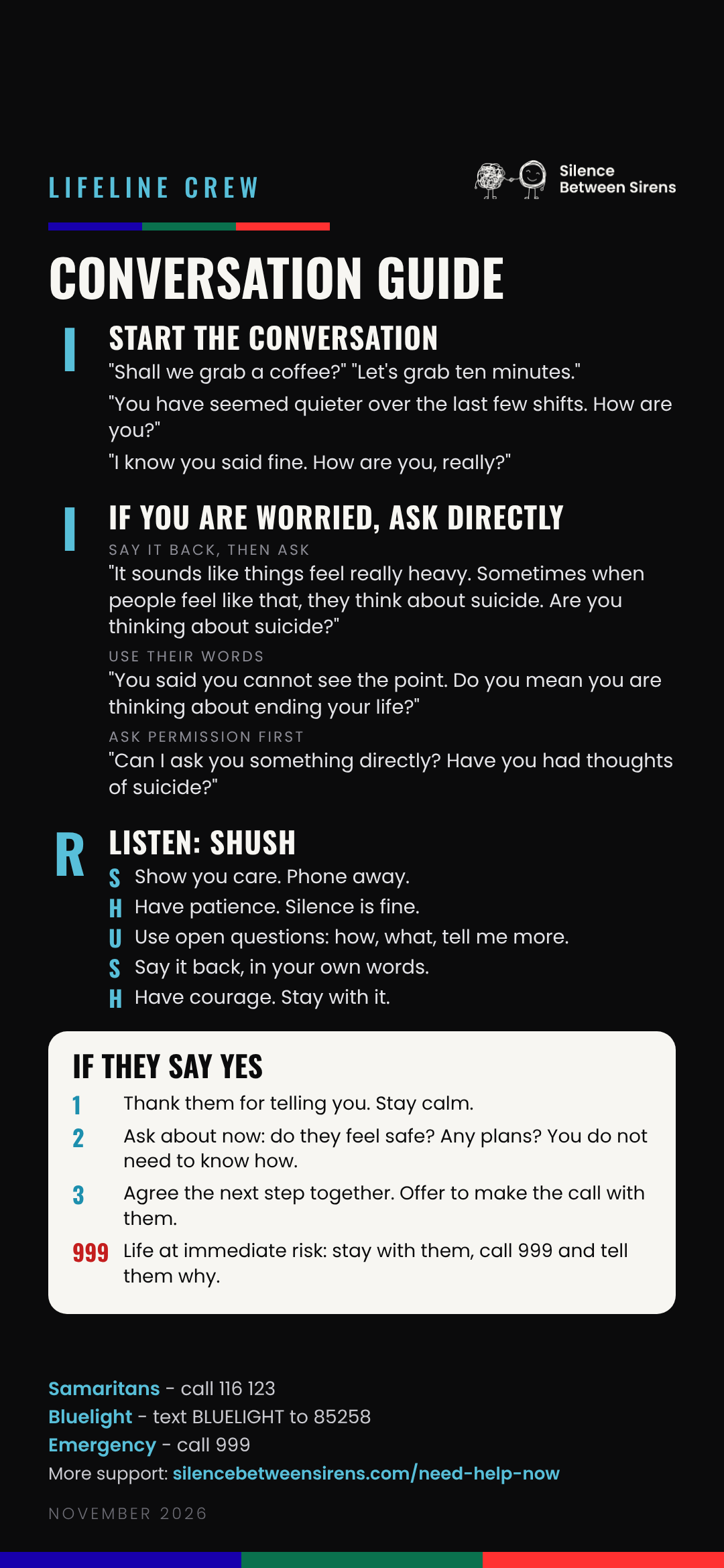
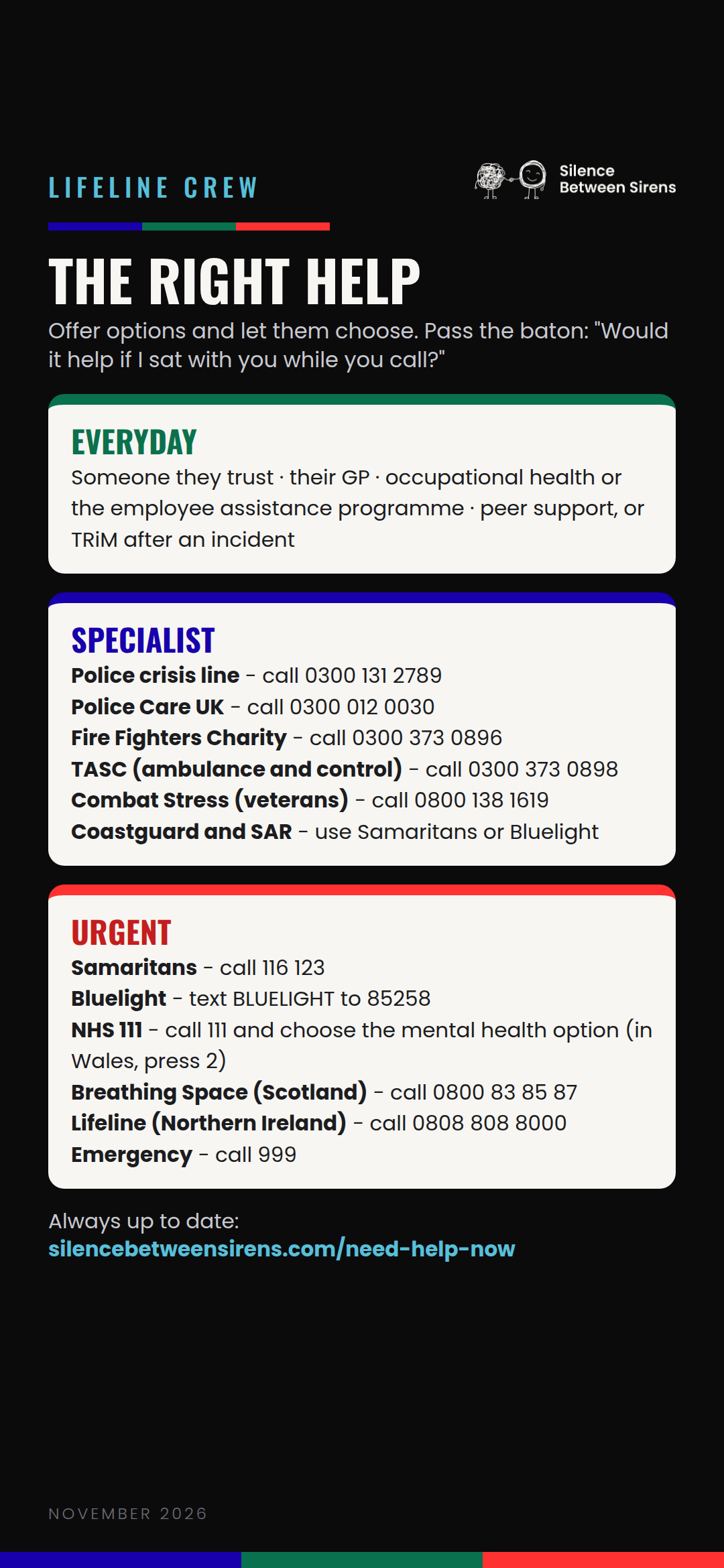
Three images for your phone.
Nothing to print and nothing to remember. We send these at the end of the session, and keep them up to date so the numbers on them are always right.
Questions people ask
How much time does it take?
There is no rota and no minimum. It fits into your normal working day.
Can I join the LifeLine Crew with my own experience of struggle?
Yes. It often helps. If a conversation brings things back, that is a reason to talk to someone, not a reason to stop.
How is this different from TRiM or Mental Health First Aid?
It does not replace either. Both do a job this does not. Foundations adds the everyday conversations between colleagues, in the language of the job.
Am I going to be asked to counsel people?
No. A LifeLine Crew member notices, asks, listens and points at the right support. Knowing where the role stops is part of the training.
Confidentiality
Members are taught to say where the line is at the start of a conversation, rather than after something has been said:
What you share stays between us, unless a life is at immediate risk, a child or vulnerable adult is at risk, or a serious crime is involved. If so, I will tell you what I need to do, and why. If something comes up that my own job means I must report, I will stop you and say so first.
After a conversation involving immediate risk, a member emails us at info@silencebetweensirens.com, where our safeguarding lead picks it up. Nobody carries it on their own.
You do not have to be at breaking point to reach out.
Silence Between Sirens is not a crisis service. These lines are free and there for you now.